
The Two Ways AI Answers Get Made, and Why YouTube Shapes Both
 Jackie Paulino

In June we shared how AI search is pulling directly from YouTube. Since then we have measured it. We asked six AI models from OpenAI, Anthropic and Google more than 300 buyer questions that ask for video, such as which video reviews to watch before buying. YouTube was not explicitly mentioned in any prompts.
YouTube was included in 85% of the answers. TikTok, the next social platform, was cited in 13%. In answers that listed their sources, youtube.com was linked 80% of the time, about seven times Wikipedia, the next most linked site.
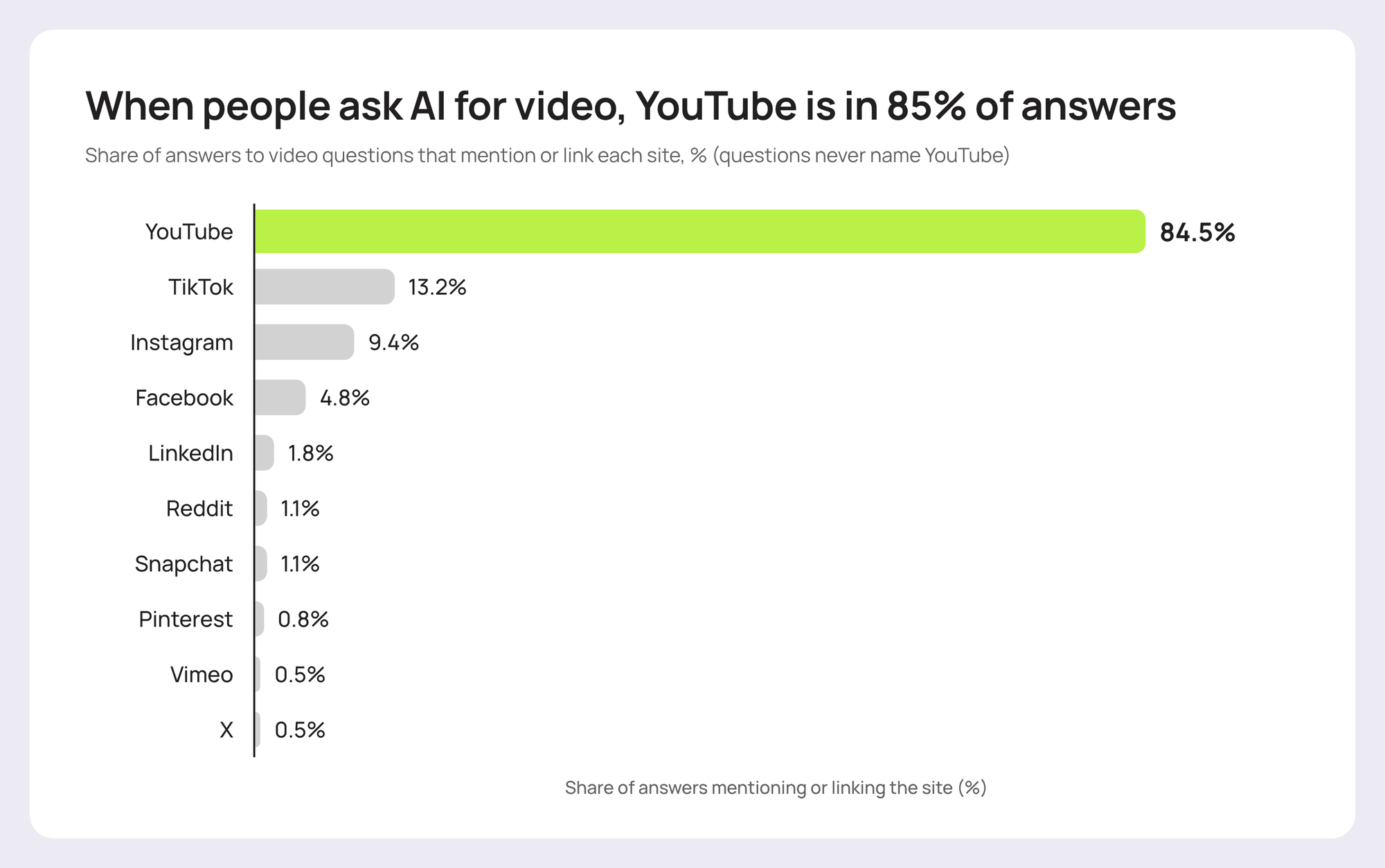
Pixability AI answer tests, Oct 2026. 5,870 answers to video questions from 6 models.
What most brands miss is where those answers come from. Every AI answer draws on two sources: what the model already knows, and what it looks up.While each needs its own strategy, YouTube is integral for both.
Two sources power AI Answers, regardless of the model
What the model knows | What the model looks up | |
|---|---|---|
Technical name | Training | RAG, retrieval-augmented generation |
What it is | Everything the model learned when it was built | A live search the model runs when you ask |
How current | Frozen at a cutoff date | Current |
How fast it changes | With each new model release | Week to week |
What it shapes | What the model believes about your brand | Which sources the answer cites |
Your strategy | Consistent long term strategy | Right now |
What the model knows: training
Before a model answers anything, it is trained on a huge amount of text: websites, books, articles and video transcripts. What it learns is then frozen at a cutoff date, months before the model ships:
OpenAI's flagship GPT-6 Astra knows the world through April 30, 2026 (OpenAI).
Anthropic's Claude Opus 5.5 knows the world through June 2026 (Anthropic).
Anything that happened after those dates is invisible to the model unless it searches. This is mostly what you read about in the news and where you hear about media companies suing OpenAI and others (NYTimes).
When a model answers from training, it looks nothing up. It describes your brand from what it absorbed in training. Whether you get mentioned depends on how often you saw it, in what context, and from which trusted sources
What the model looks up: RAG
When a question needs current or specific information, the model runs a search first. You may remember using ChatGPT when it first came out and it couldn't answer any questions about recent news, this was because it did not have this feature yet. Today, about a third of ChatGPT prompts trigger a live search, 34.5% as of February 2026 (Semrush). Google's AI Overviews and AI Mode work the same way, pulling from Google's search index (Google Search Central).
Buyer questions trigger search far more often. In our tests, the ChatGPT and Claude models ran a live search on 89% of video questions.
RAG is not the same as search. Search finds and ranks pages. RAG uses search as its first step, then reads the results and writes the answer. Think of it as search plus a writer.
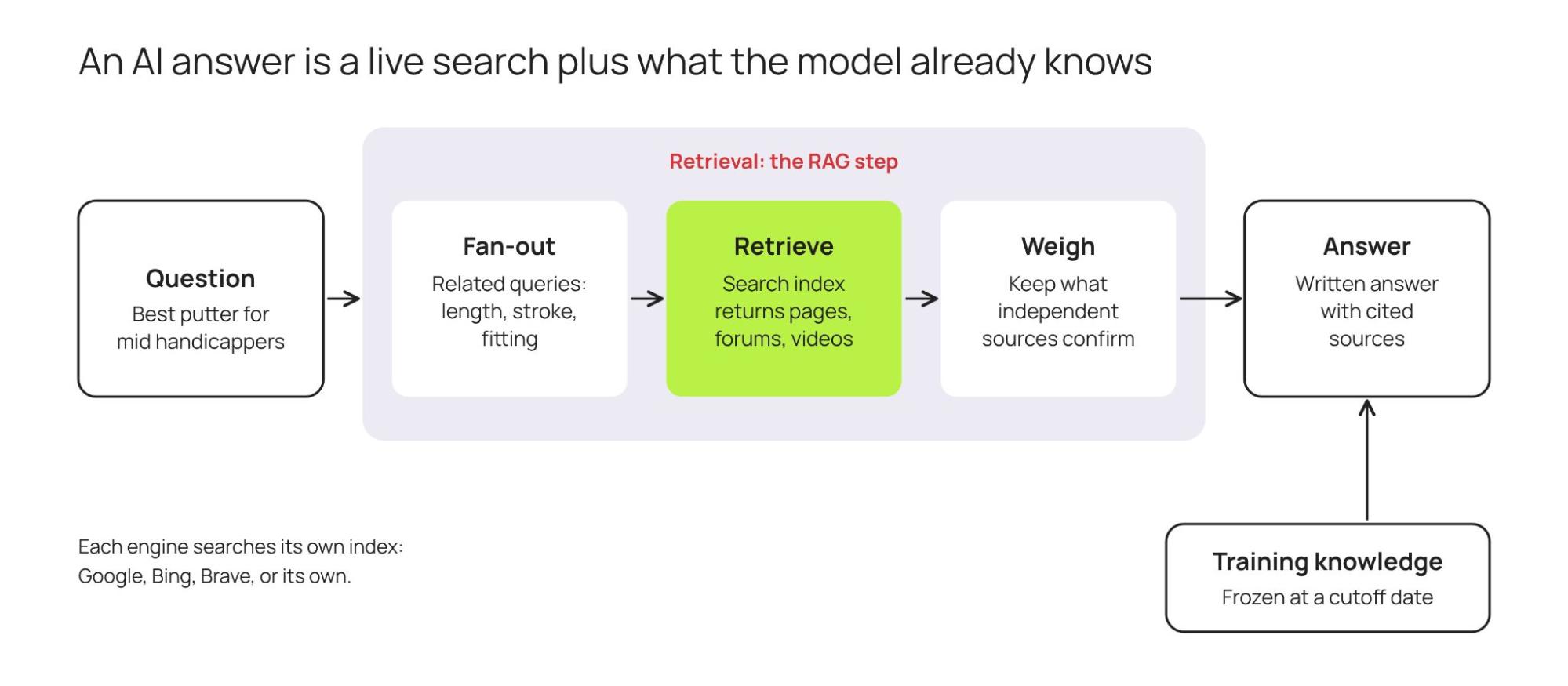
Fan-out. The model turns one question into several related searches. A question about the best putter also searches how to choose one, putter length and fitting.
Retrieve. Each search returns pages, reviews, forums and videos from a search index. Google uses its own, ChatGPT uses Bing plus its own, Claude uses Brave.
Weigh. The model favors what several independent sources agree on.
Answer. It writes the answer and cites a few sources.
If your content is not in the index, the model never sees it.
Win over Models with two key strategies
Right now: win the search
This is where citations come from, and it moves fast. Our data shows what wins.
Make the videos AI recommends. About 70% of the YouTube videos the models cited fit four formats:
Format | Share of cited videos |
|---|---|
Reviews | 23% |
How-tos and guides | 22% |
Comparisons | 19% |
Best-of lists | 13% |
Unboxings were under 1%. Models want videos that help someone decide, not product reveals.
Publish long-form videos that answer buyer questions, with clear titles, chapters and captions.
Cover the whole category, not just your product. Fan-out rewards how-tos, comparisons and buying guides.
Measure on a schedule. Citations fade: one tracker saw them fall about 43% within a month of first appearing (Relevant Audience).
Creators are the answer
AI models cite creators, not brands. 89% of the YouTube videos they cited came from creators. Brands made 11%, counting retailers, publishers and health organizations.
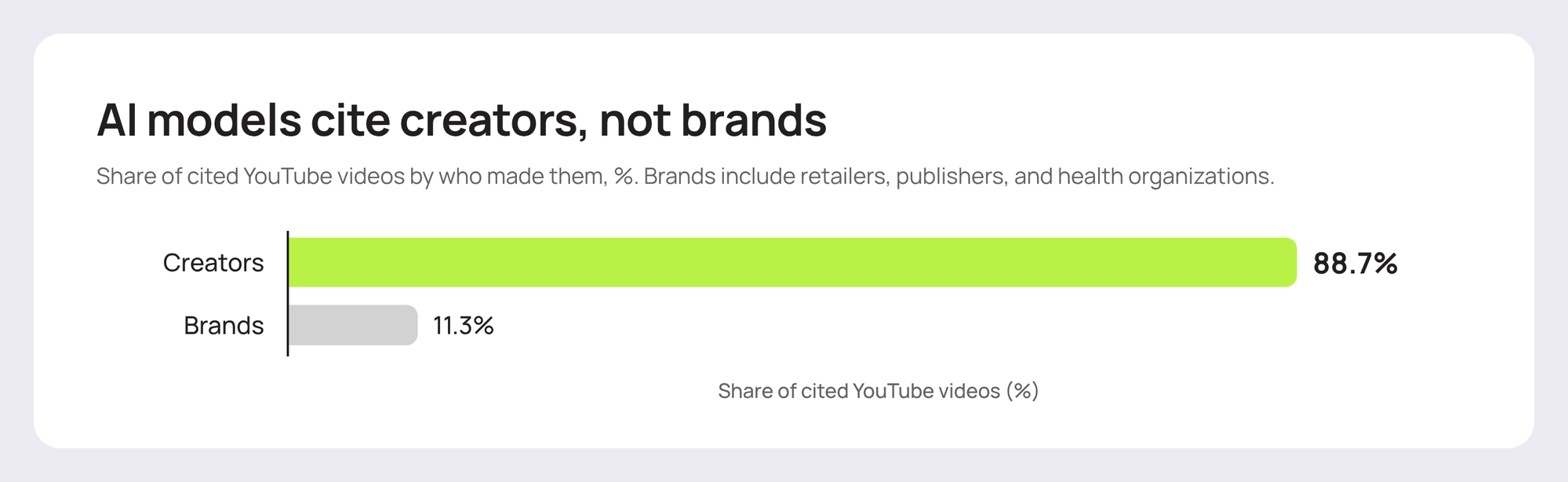
Pixability AI answer tests, Oct 23 to 27, 2026. 7,496 citations of the 1,000 most cited videos.
Mid-size creators win. 79% of creator citations went to channels under 100,000 subscribers. Channels over 1 million got 3%.
The field is wide. Across 10 brands, 534 different creator channels were cited.
The reason is authority. Models favor sources that look independent, specialized and consistent on a topic. A creator who reviews golf gear every week reads as an expert. A brand channel reads as an ad.
What a creator strategy for AI looks like:
Find and partner with the creators that the models already cite for your category, prioritizing topic depth over subscriber count
Lean into the formats models favor: honest reviews, comparisons and how-tos.
Use paid media to amplify their videos. In Pixability's channel management work, SEO-optimized channels with paid support drove 2.8x more organic views than SEO alone (Pixability).
Pixability now tracks which creators the models cite, by brand and category, across six models from OpenAI, Anthropic and Google. A creator who gets cited again and again has proven authority with the foundational models. That list is a stronger starting point for partnerships than subscriber counts alone.
Your own channel still matters
Brands earned 11% of the citations, showing that a brand channel can make it into the answer. However, the brands that were cited run their channels like publishers, posting reviews, guides and explainers on a regular schedule.
In our experience, Most brand channels are not built that way. Instead, they become a dumping ground for launch spots, sizzle reels and ad cuts, uploaded with no strategy and giving models nothing useful to cite and no reason to see the brand as an authority.
Build a channel strategy
Answer the questions buyers ask, not just the products you launch
Organize videos into playlists by topic, so the channel reads as a library
Add chapters, captions and descriptions written in buyer language
Publish on a schedule. Consistency builds authority
Feature the creators who already get cited for your category
Long term: shape what models learn
This decides how models describe you when they do not search. You cannot see inside it, so consistency is the strategy.
Authority is the long game. Models learn who is credible on a topic from how often, and how consistently, independent sources say so. The creators cited today become the sources the next model learns from.
Show up often and accurately in the places models learn from.
Earn outside coverage. Creator reviews and independent articles count for more than your own claims.
Get brand and product names right in titles, descriptions and captions, so the text models learn from is correct.
YouTube matters for both
For search. YouTube is the most cited site in Google's AI Overviews, at 29.5% of citations (BrightEdge). It was the most cited platform across eight AI engines in August 2026 (Relevant Audience). In our tests it was in 85% of answers to video questions.
For training. Google has confirmed it trains Gemini on a subset of YouTube videos (CNBC).
The same video does both jobs. A strong video can get cited this week and shape what the next model learns.
Skip the shortcuts. Google says llms.txt files, chunked content and fake mentions do not help (Google Search Central).
The takeaway: Win search today. Shape what AI learns next.
AI answers come from two places: what the model knows and what it looks up. Win the search now, and build the presence that shapes what models learn next. YouTube is the one channel that does both.