
VTubers, Explained: What a VTuber Is, and What They Mean for YouTube Advertisers

Summary:
- VTubers are digital creators, not AI (even though it sometimes feels like it).
A VTuber is a real person performing through a virtual avatar, using motion capture and real-time animation to engage audiences on YouTube. - High engagement does not equal broad brand suitability.
VTuber audiences are highly participatory and loyal, but also insular, context-specific, and sensitive to authenticity.
- VTuber audiences are highly engaged and community-driven.
Fans don’t just watch VTubers – they actively participate, making engagement levels an important consideration for advertisers. - Brand fit matters far more than scale.
VTuber partnerships work best when integrations feel native to the creator’s character and audience, rather than forced sponsorships. - The definition of “VTuber” is evolving.
The term now includes a wider range of virtual creators and digital personas, blurring lines between VTubers, virtual influencers, and branded avatars. - For advertisers, VTubers are an emerging test-and-learn opportunity.
They aren’t right for every brand, but they offer a way to reach digitally native audiences in environments where traditional creator formats may not resonate. - The format and verticals are expanding, but remain somewhat niche.
VTubers have moved beyond gaming into entertainment and branded content, but adoption is uneven and still concentrated in specific subcultures.
First Things First: What Is a VTuber?
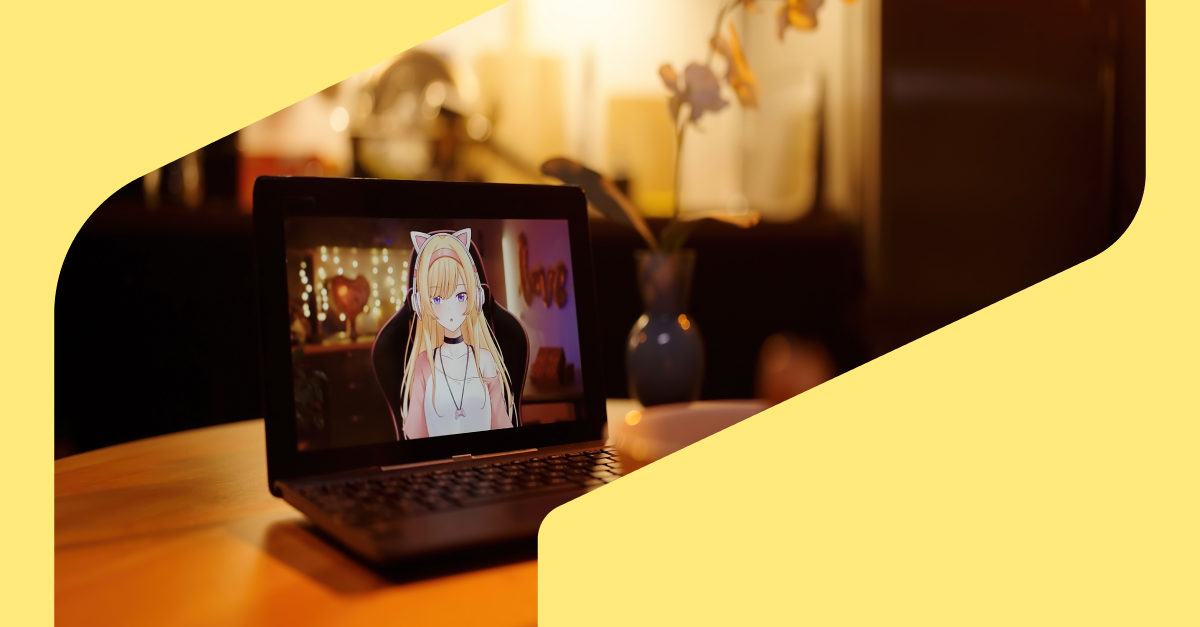
A VTuber – short for Virtual YouTuber – is a digital content creator who appears on screen as a computer-generated avatar instead of showing their real face. Behind the scenes, a real person controls the avatar using motion capture, facial tracking, and voice input, allowing the character to move, speak, and interact with audiences in real time. So while VTubers are technically not “AI”, many rely on advanced animation pipelines, real-time rendering, and automation tools that make the experience feel closer to synthetic media than traditional creator content.
In simple terms:
A VTuber is a creator using a virtual character to produce YouTube content.
While VTubers first gained popularity in Japan, the format has expanded globally and is now a growing part of YouTube’s creator ecosystem.
How Do VTubers Work?
Instead of filming themselves on camera, VTubers use a combination of creative and technical tools, including:
- 2D or 3D digital avatars (illustrated or CGI characters)
- Facial and body tracking software
- Real-time animation tools
- Live audio and performance inputs
This setup allows VTubers to react instantly to viewers, play games, host livestreams, and deliver scripted or unscripted content – just like traditional creators, but through a virtual persona.
Some VTubers use simple, stylized 2D characters. Others, like the wildly popular Gawr Gura and Takanashi Kiara, for example, operate highly sophisticated 3D avatars with lifelike movement. This flexibility makes VTubing adaptable across genres and production budgets.
However, this heavy use of animation and rendering also means the on-screen experience often feels more like a digital character than a human creator – especially to casual viewers.
From an advertiser perspective, this distinction matters.
Where VTubers Appear on YouTube
VTubers are most commonly found in:
- Gaming and livestream content
- Entertainment and commentary videos
- Music, performance, and virtual concerts
- Community-driven livestreams
- Sponsored or branded integrations
While gaming remains the most visible entry point, VTubers are increasingly expanding into broader verticals and entertainment formats, making the category more relevant to mainstream advertisers.
Some examples of advertiser-VTuber sponsorships include major tech brands like RHINOSHEILD and iBUYPOWER sponsoring one of the most popular VTubers in the US, Hololive.
Why VTubers Are Growing in Popularity
Interest in VTubers has increased as audiences grow more comfortable with digital identities and avatar-based media. The massive growth of search terms like “vtuber meaning” and “what is a vtuber” reflects how the format is moving from niche to mainstream awareness.
Compared to traditional creators, VTubers offer:
- Anonymity for the performer
- Creative freedom without real-world constraints
- Highly engaged niche communities
- Strong fan loyalty and community engagement
- Cross-platform appeal across YouTube, Twitch, TikTok, and more
However, for advertisers, these same traits can limit scalability and brand alignment.
Due to that risk, the question inevitably presents: Is there a way for advertisers to avoid VTubers?
Luckily, brand suitability partners like Pixability can employ exclusion lists, which give advertisers the option to exclude VTubers whose content may not be a fit. Advertisers have a options for how to apply exclusions:
- Maintain a small manual blocklist of specific VTuber channels
- Add one exclusion that removes channels labeled “VTuber” or linked to networks (i.e. Hololive)
- Only use broad gaming or language exclusions if you’re willing to lose non‑VTuber reach, then update the manual list and VTuber exclusion regularly
What VTubers Mean for Advertisers
For brands, VTubers represent both opportunity and caution.
Potential benefits for (the right, highly niche) advertisers:
- High engagement: VTuber audiences are often highly loyal and interactive.
- Creative flexibility: Avatars can be customized, themed, or aligned with specific campaigns.
- Appeal to younger, digitally native audiences.
Key limits:
That said, VTubers are not a default creator solution. They often represent a narrow test-and-learn opportunity rather than a broadly applicable strategy:
- VTuber audiences are often insular and context-specific
- The content can feel synthetic or AI-like, even when human-operated
- Poor integrations stand out quickly and can alienate viewers
- Many categories and brand tones are simply incompatible
Therefore, the most effective VTuber partnerships tend to be:
- Native to the content
- Transparent
- Aligned with the creator’s character and audience expectations
How the Term “VTuber” Is Evolving
Originally, “VTuber” referred almost exclusively to Japanese anime-style creators. Today, the term is broader and evolving.
We’re seeing:
- Western creators adopting VTuber formats
- Brands experimenting with virtual brand ambassadors
- Hybrid creators blending real and virtual identities
- Growing overlap between VTubers, AI avatars, and virtual influencers
As avatar technology improves, the line between “VTuber,” “virtual influencer,” and “digital persona” will continue to blur – especially on YouTube.
The Bigger Picture for YouTube and Media Strategy
The rise of VTubers signals a broader shift in how audiences engage with creators and how advertisers think about influence.
For marketers, the question isn’t “Should we advertise with VTubers?”
It’s “Where do virtual creators fit into our broader YouTube and creator strategy?”
Understanding emerging formats like VTubers helps brands stay culturally relevant, experiment responsibly, and prepare for what’s next in digital video.
Pixability helps advertisers navigate new creator formats, emerging YouTube trends, and performance-driven media strategies with precision and insight.
To discover what evolving creator formats can mean for your YouTube strategy, reach out to us today!